1742 0 open problems
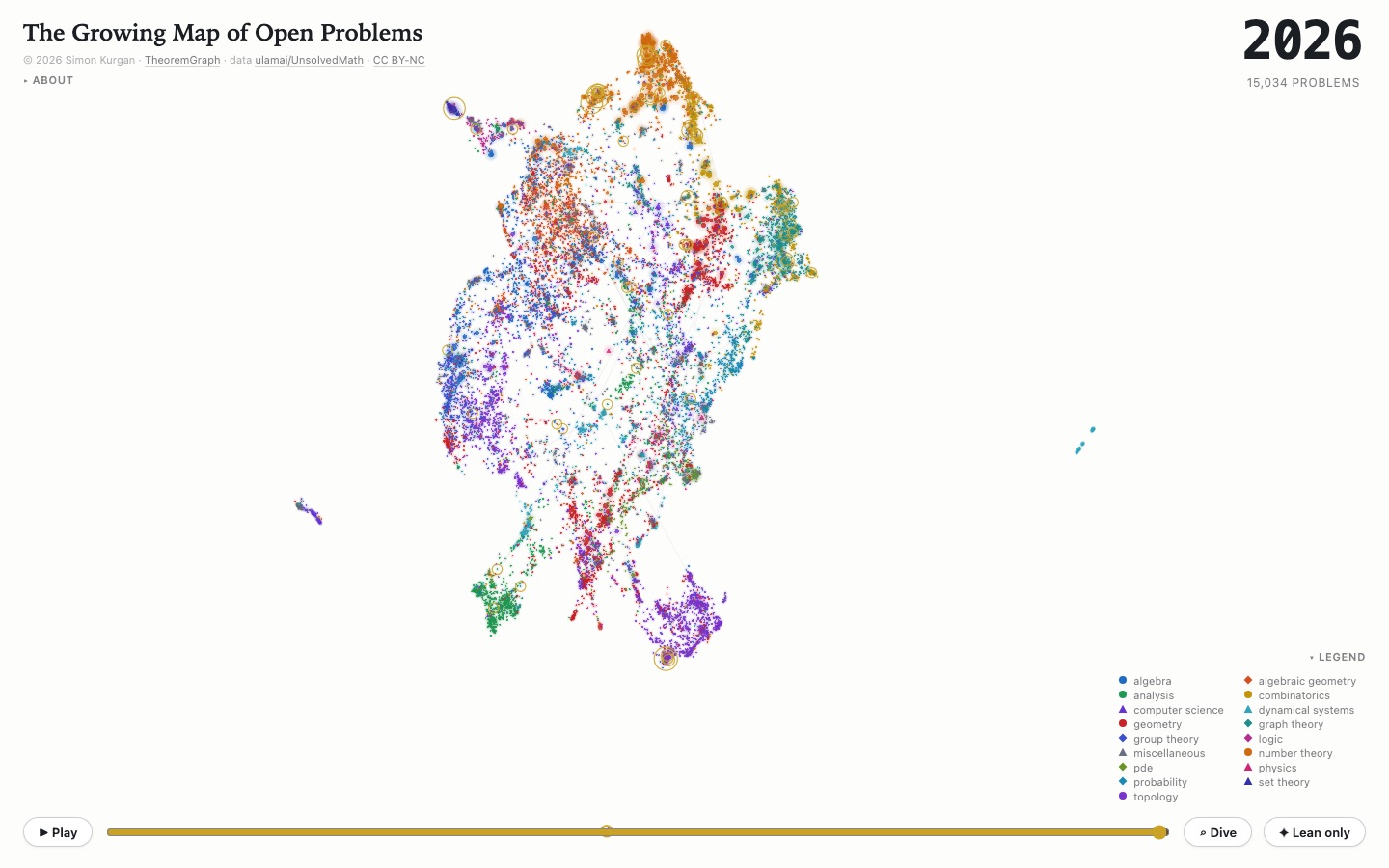
77 problems already stated in Lean Hover any point to read the problem The Growing Map of Open Problems Simon Kurgan

Math AI Lab

The University of Washington Math AI Lab is a research and education organization focused on using AI for math, founded by Jarod Alper and Vasily Ilin.

16papers
76projects
178undergraduate students
19graduate students
10professors

Fall 2026 Projects

All 76 projects →

We are excited to run 14 projects involving 60 students! Meetings are scheduled for Mondays & Wednesdays from September 30 - December 11. We expect to reopen applications in December for Winter 2027.

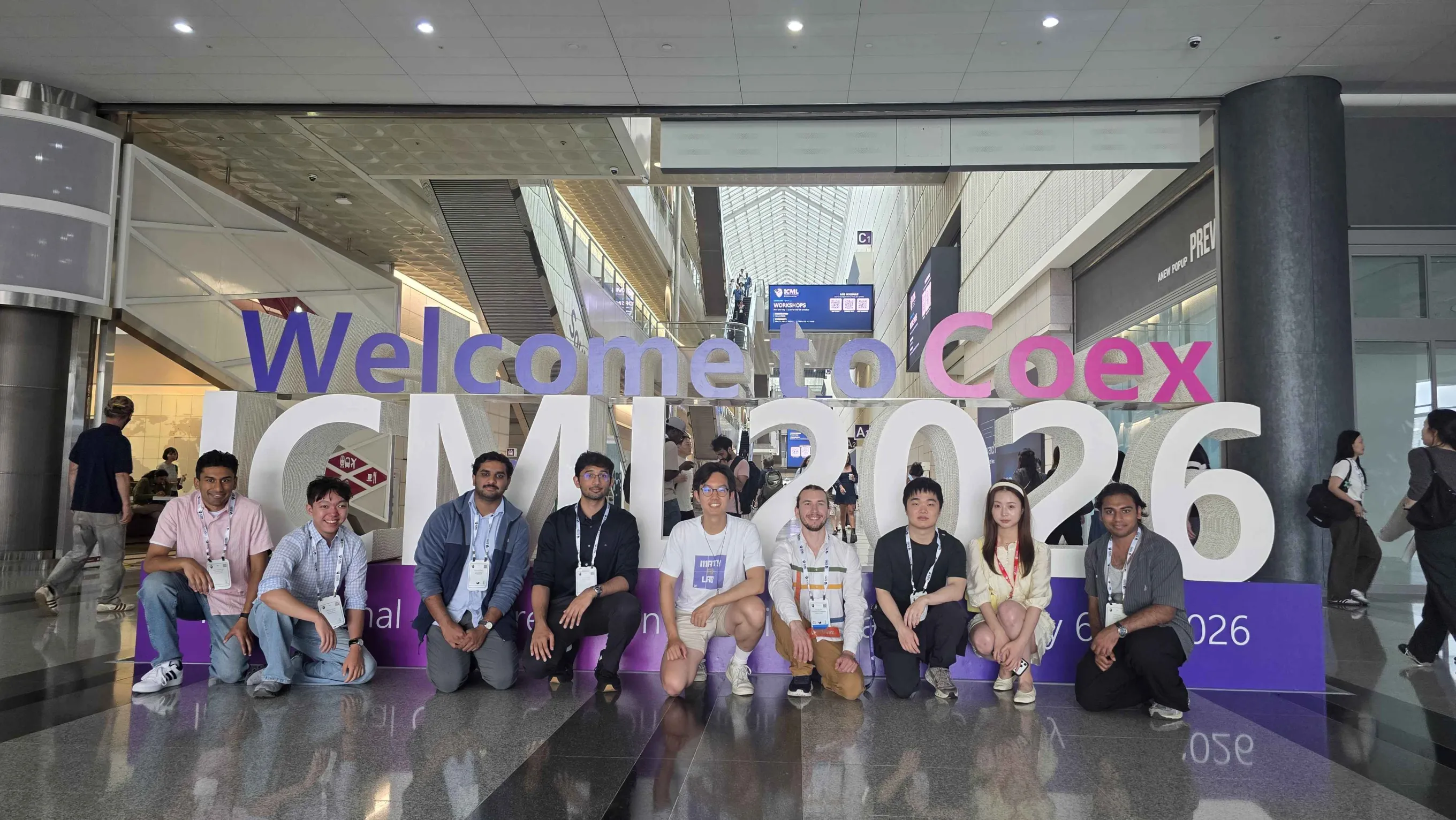
Math AI Lab group at ICML 2026 in COEX, Seoul

Eight Math AI Lab papers accepted to ICML 2026

The lab celebrates eight papers accepted to ICML 2026 and its workshops. DiScoFormer was selected for an oral presentation, and Multiplication Beyond Groups received a Spotlight at the Mechanistic Interpretability Workshop.

Read more: Eight Math AI Lab papers accepted to ICML 2026 →
  1. ICML 2026Oral presentation
    DiScoFormer: Plug-In Density and Score Estimation with Transformers

    Estimating probability density and its score from samples remains a core problem in generative modeling, Bayesian inference, and kinetic theory. Existing methods are bifurcated: classical kernel density estimators (KDE) generalize across distributions but suffer from the curse of dimensionality, while modern neural score models achieve high precision but require retraining for every target distribution. We introduce DiScoFormer (Density and Score Transformer), a "train-once, infer-anywhere" equivariant Transformer that maps i.i.d. samples to both density values and score vectors, generalizing across distributions and sample sizes. Analytically, we prove that self-attention can recover normalized KDE, establishing it as a functional generalization of kernel methods; empirically, individual attention heads learn multi-scale, kernel-like behaviors. The model converges faster and achieves higher precision than KDE for density estimation, and provides a high-fidelity plug-in score oracle for score-debiased KDE, Fisher information computation, and Fokker-Planck-type PDEs.

  2. NeurIPS 2026 Evaluations and Datasets TrackPoster
    Semantic Search over 9 Million Mathematical Theorems

    Searching for mathematical results remains difficult: most existing tools retrieve entire papers, while mathematicians and theorem-proving agents often seek a specific theorem, lemma, or proposition that answers a query. While semantic search has seen rapid progress, its behavior on large, highly technical corpora such as research-level mathematical theorems remains poorly understood. In this work, we introduce and study semantic theorem retrieval at scale over a unified corpus of 9.2 million theorem statements extracted from arXiv and seven other sources, representing the largest publicly available corpus of human-authored, research-level theorems. We represent each theorem with a short natural-language description as a retrieval representation and systematically analyze how representation context, language model choice, embedding model, and prompting strategy affect retrieval quality. On a curated evaluation set of theorem-search queries written by professional mathematicians, our approach substantially improves both theorem-level and paper-level retrieval compared to existing baselines, demonstrating that semantic theorem search is feasible and effective at web scale. The project page, search tool, dataset, REST API, and MCP server are available at theoremsearch.com.

  3. TAG-DS 2026SpotlightICML 2026, AI for Math WorkshopPoster
    Does My Embedding Reflect That A = B? Evaluating Mathematical Equivalence in Embedding Models

    Because mathematics is highly abstract, a single statement can take very different forms depending on what subfield it is framed in. There are many examples where breakthroughs occurred after researchers discovered that a question had already been answered in a different field. At the same time, the growth of new resources related to formalization has increased the need for tools that enable efficient and reliable navigation between mathematical 'languages' (e.g., from Lean to natural language). In this paper, we investigate whether current embedding models capture mathematical equivalence. To do this, we introduce the Mathematically Equivalent but Lexically Different Pairs (MELD) Dataset, a collection of mathematically equivalent statements that are expressed in very different language. We show that current state-of-the-art embedding models tend to group statements by the terminology used to make them instead of the underlying math. Motivated by this, we propose a contrastive approach to learning embeddings of mathematical text that focuses on aligning informal statements with different formalizations. Our experiments demonstrate that this leads to improvements not only on informal-formal retrieval tasks but also on MELD, which only contains natural language statements.

  4. ICML 2026, Mechanistic Interpretability WorkshopSpotlight
    Multiplication Beyond Groups: Stratified Fourier Mechanisms in Transformer Circuits

    Transformers have demonstrated a remarkable ability to learn algorithmic reasoning, yet mechanistic analyses have mostly focused on globally invertible operations such as cyclic addition and group composition. In this work, we investigate how small transformers learn modular integer multiplication over composite moduli, a fundamentally non-invertible operation due to the presence of zero-divisors. We propose the monoid extension: a localized generalization of Group Composition via Representation (GCR) that suggests the learned computation does not rely on a single global representation space. Instead, the model partitions the input space into local hierarchical algebraic regions, where group-like structure survives and Fourier mechanisms can be applied. In transformers trained on square-free modular multiplication, we find that embeddings organize around these regions, attention exhibits class-sensitive routing and low-rank write directions, and local character features explain a large fraction of the model's output logits. Our results suggest that representation-theoretic mechanisms previously identified for group operations can extend beyond groups to more general structures.

  5. ICML 2026, AI for Math WorkshopPoster
    Semi-Autonomous Formalization of the Vlasov-Maxwell-Landau Equilibrium

    We present a complete Lean 4 formalization of the equilibrium characterization in the Vlasov-Maxwell-Landau (VML) system, which describes the motion of charged plasma. The project demonstrates the full AI-assisted mathematical research loop: an AI reasoning model (Gemini DeepThink) generated the proof from a conjecture, an agentic coding tool (Claude Code) translated it into Lean from natural-language prompts, a specialized prover (Aristotle) closed 111 lemmas, and the Lean kernel verified the result. A single mathematician supervised the process over 10 days at a cost of $200, writing zero lines of code. The entire development process is public: all 229 human prompts, and 213 git commits are archived in the repository. We report detailed lessons on AI failure modes -- hypothesis creep, definition-alignment bugs, agent avoidance behaviors -- and on what worked: the abstract/concrete proof split, adversarial self-review, and the critical role of human review of key definitions and theorem statements. Notably, the formalization was completed before the final draft of the corresponding math paper was finished.

  6. ICML 2026, AI for Math WorkshopPoster
    FactorLibrary: From Polynomials to Circuits via Recursive Subgoals

    Finding minimal arithmetic circuits for polynomials over finite fields is a combinatorially hard problem central to algebraic complexity theory. We formulate it as a reinforcement learning problem in two directions, bottom-up and top-down. To address the challenge of a fast-growing combinatorial search space, we introduce FactorLibrary, which stores factorizable subexpressions that serve as reusable subgoals across training episodes. We trained a bottom-up agent with Gumbel-PPO-MCTS and two top-down agents with PPO+MCTS and SAC. The PPO+MCTS top-down agent exhibited the most stable performance, finding certified optimal circuits up to complexity 8 with a success rate of 91.8%.

  7. Mathlib Contribution, 2026Merged
    Finite Étale Extensions of Local Rings Are Monogenic

    Formalizes finite étale local-ring monogenicity and the unit derivative of a generator's minimal polynomial.

  8. Mathlib Contribution, 2026Merged
    mkOfAdjoinEqTop' for Adjoined Roots

    Generalizes an adjoined-root construction, replacing the integrally closed hypothesis with module freeness.

Community

People →
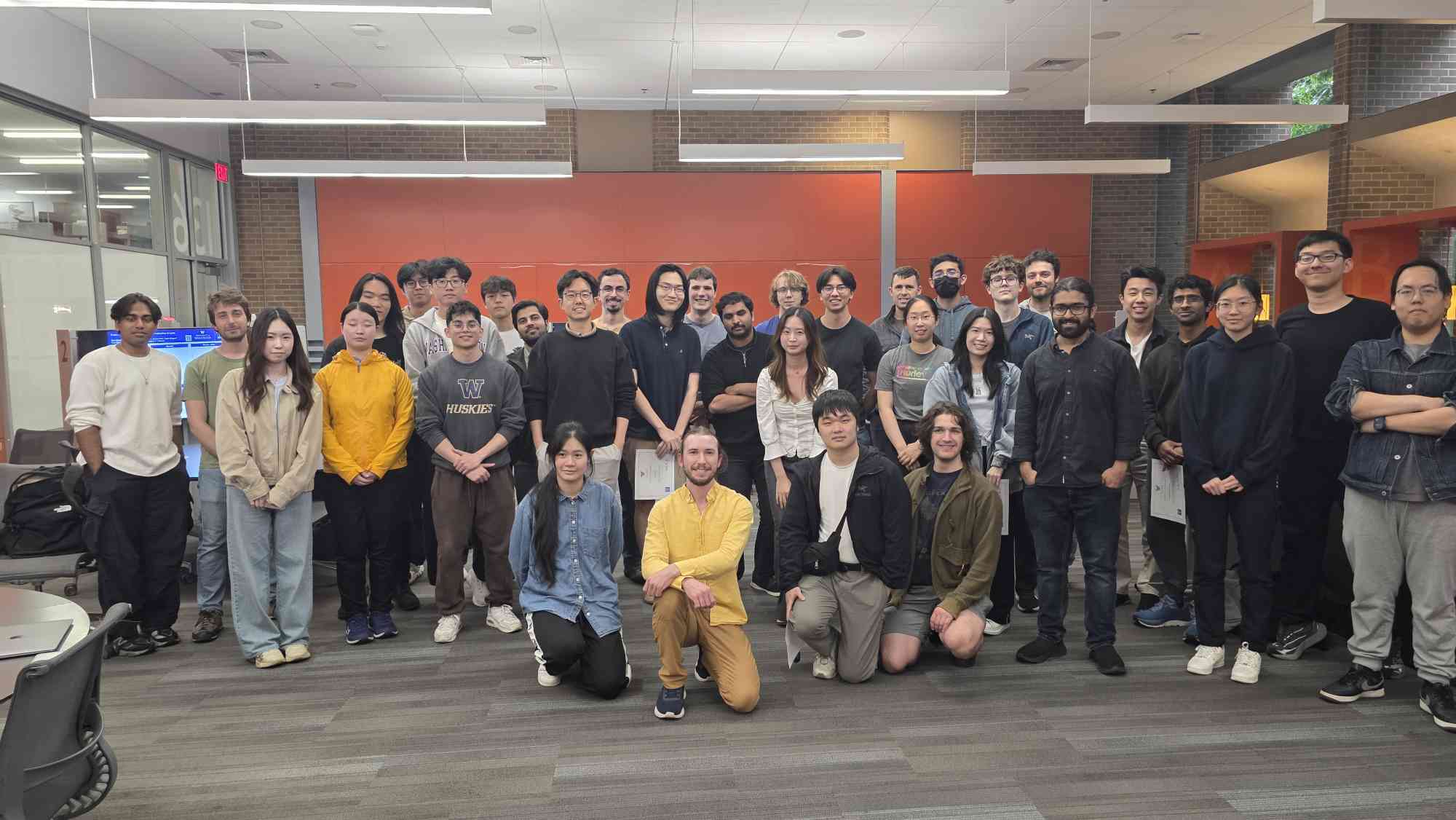
Math AI Lab members and project teams standing together at Spring 2026 demo day
Spring 2026 demo day, June 8, 2026
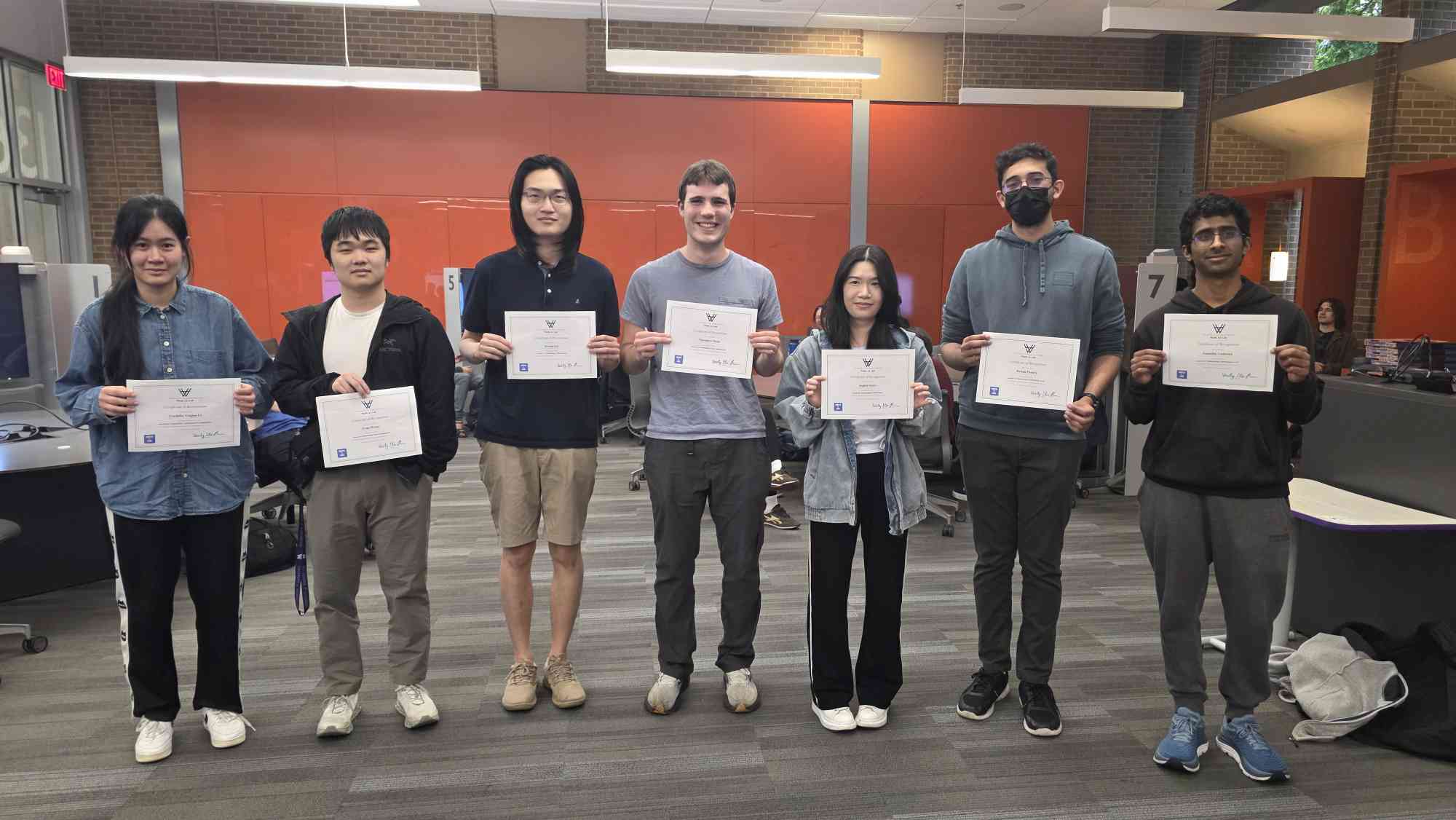
Seven Math AI Lab members each holding a certificate of recognition at Spring 2026 demo day
Certificates of recognition, Spring 2026 demo day

Tools