
Fall 2026 social event
Event details
The Fall 2026 social event for lab members.
News, gatherings, and writing from our community.
The Fall 2026 social event for lab members.
We're kicking off the quarter with our inaugural lab meeting. We'll introduce the different projects happening in the lab, share some logistics for how things will run this quarter, and give everyone a chance to get oriented and meet the broader lab community. All participants and visitors are welcome to join!
"Semantic Search over 9 Million Mathematical Theorems" was accepted to the NeurIPS 2026 Evaluations & Datasets Track as a poster.
Project leader applications for Fall 2026 are open! We are recruiting leaders for projects in four areas: machine learning and AI for math, formalization and autoformalization, autoresearch, and AI for math education and learning.
Applications are due Monday, September 7 at 11:59 pm, and earlier applications have priority. Mentors of continuing projects are required to fill it out. The project descriptions are linked below.
Samarth presented “Does My Embedding Reflect That A = B?” at TAG-DS 2026 in Boston.
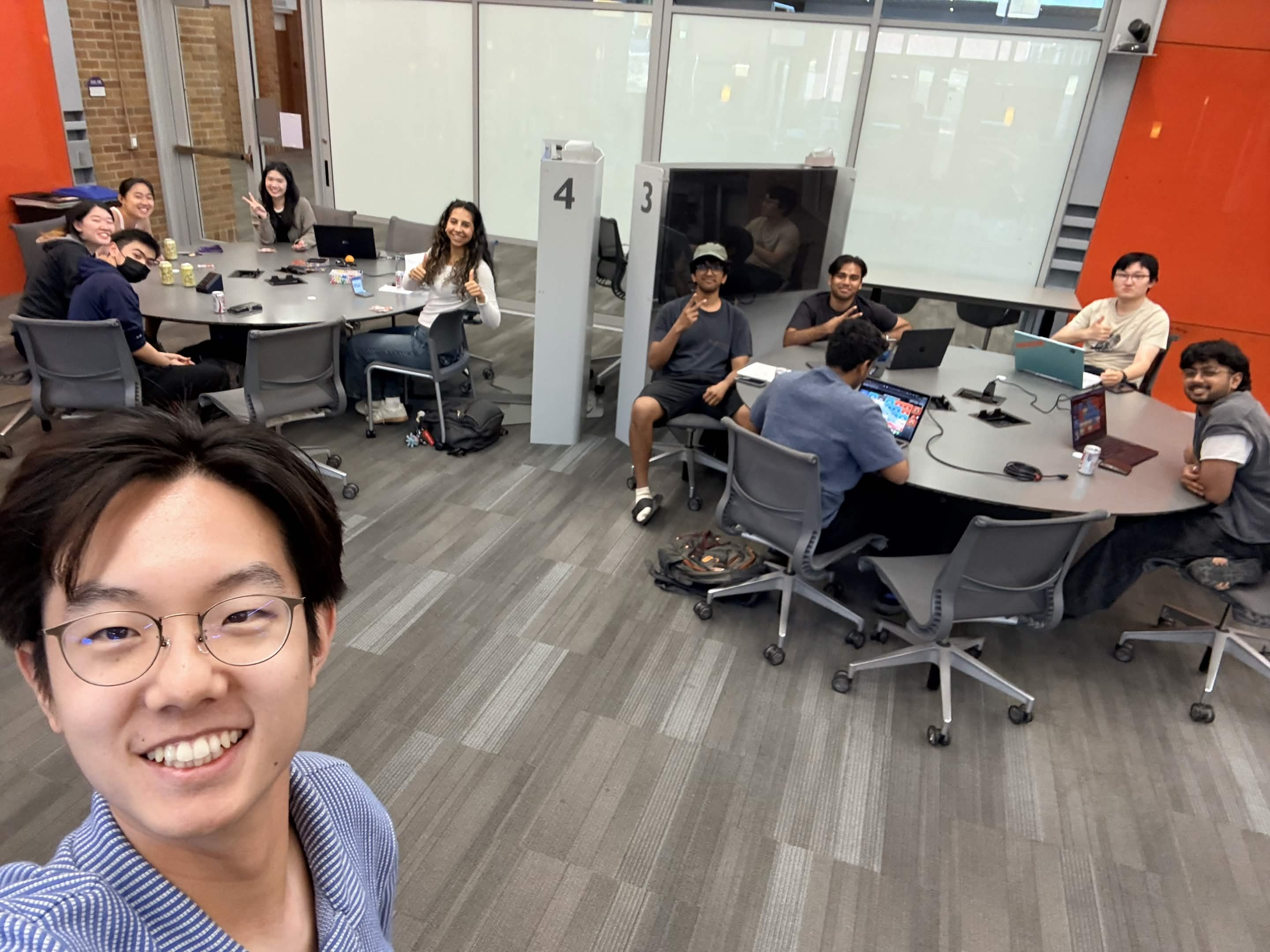
Come join us on Monday July 20th in OUG 136 to chat with your colleagues about their exciting research! Food and board games provided
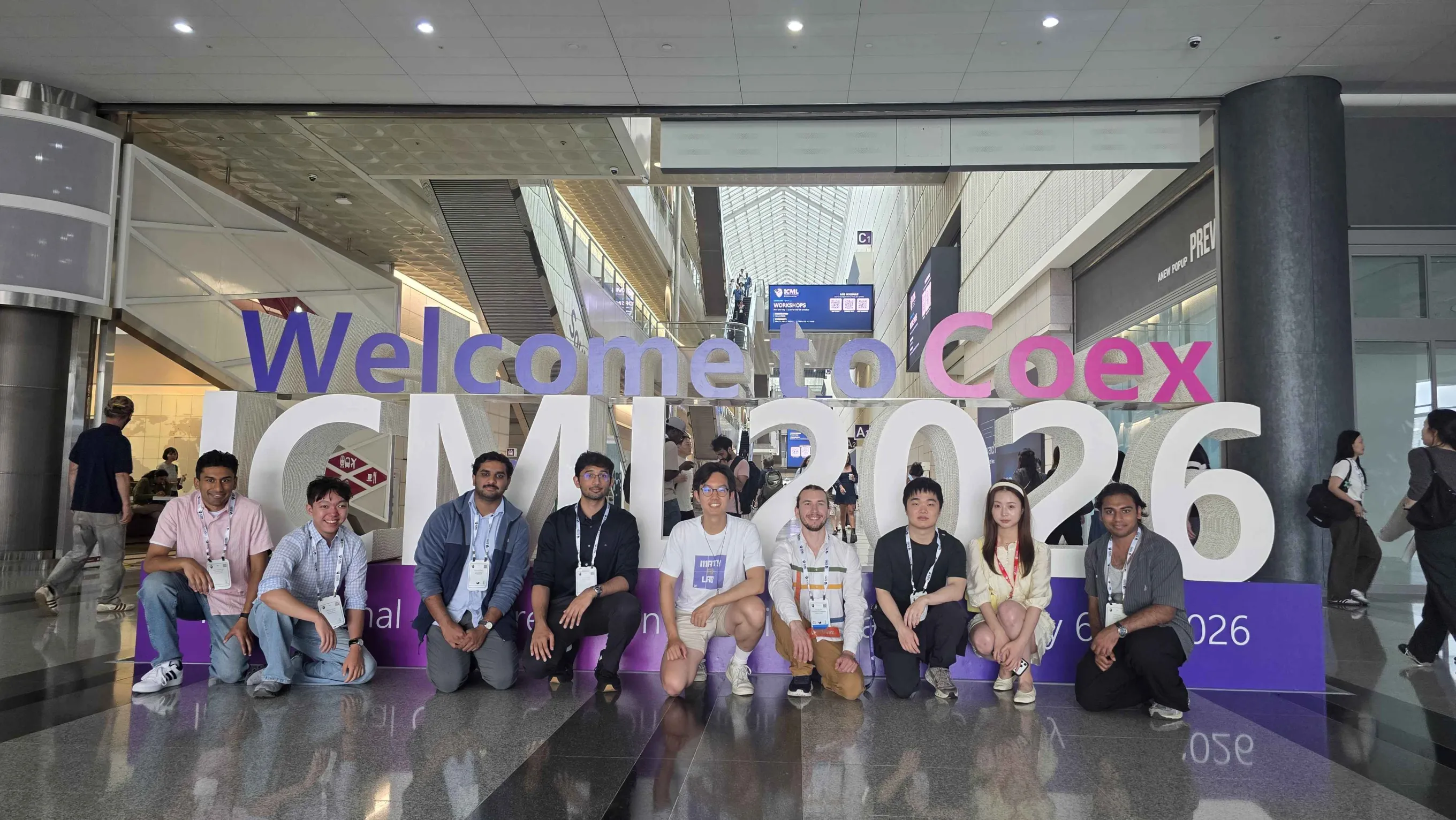
The lab celebrates eight papers accepted to ICML 2026 and its workshops. DiScoFormer was selected for an oral presentation, and Multiplication Beyond Groups received a Spotlight at the Mechanistic Interpretability Workshop.
StabilizerBench was accepted to the QSYS technical-paper track as a poster.
The spring quarter poster session will bring together every Math AI Lab team, with each team represented through a poster or interactive demo.
Vasily Ilin
I will summarize my PhD research, concentrating on two areas: machine learning for plasma simulation, and AI for formalizing mathematics in Lean.
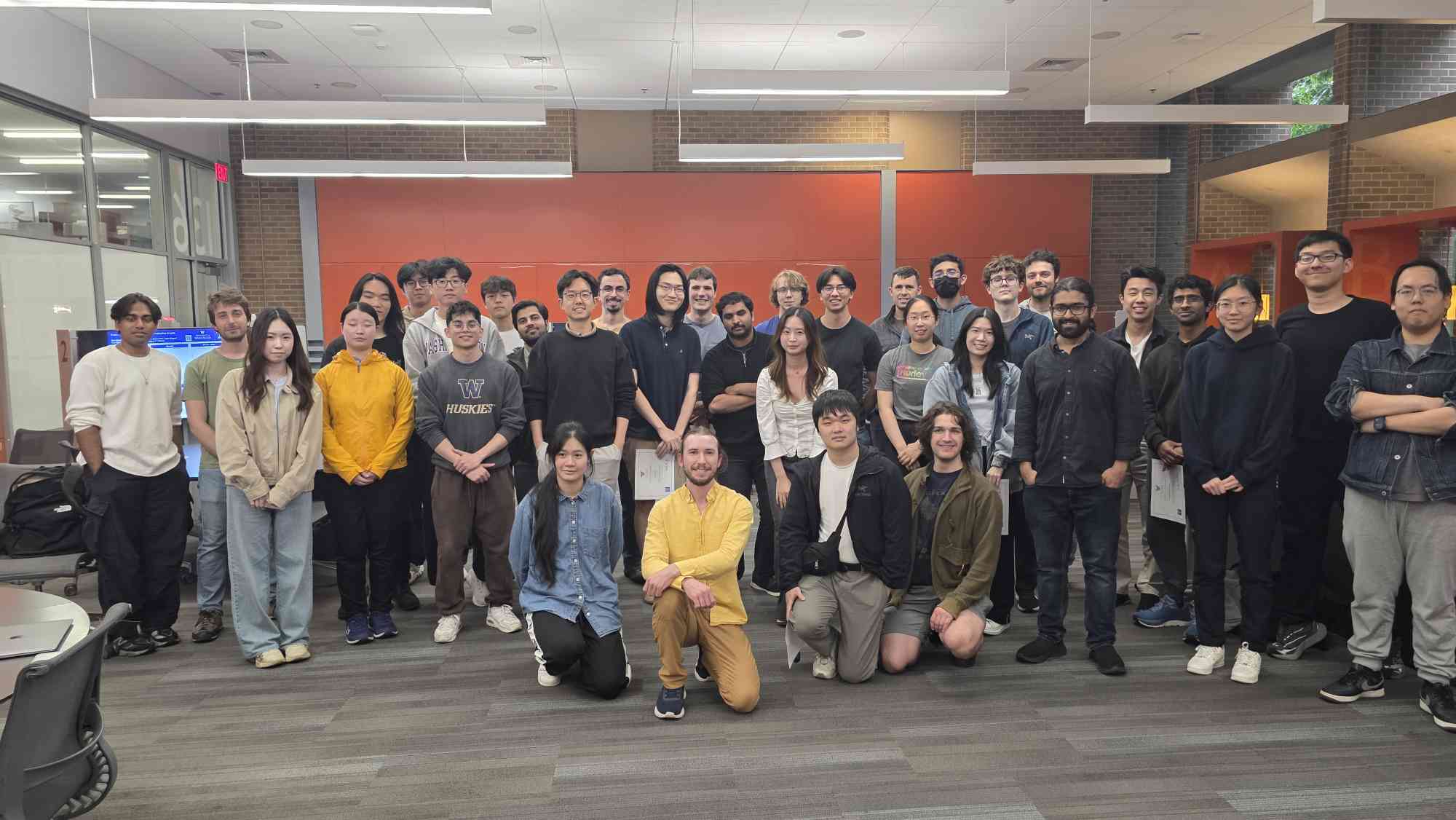
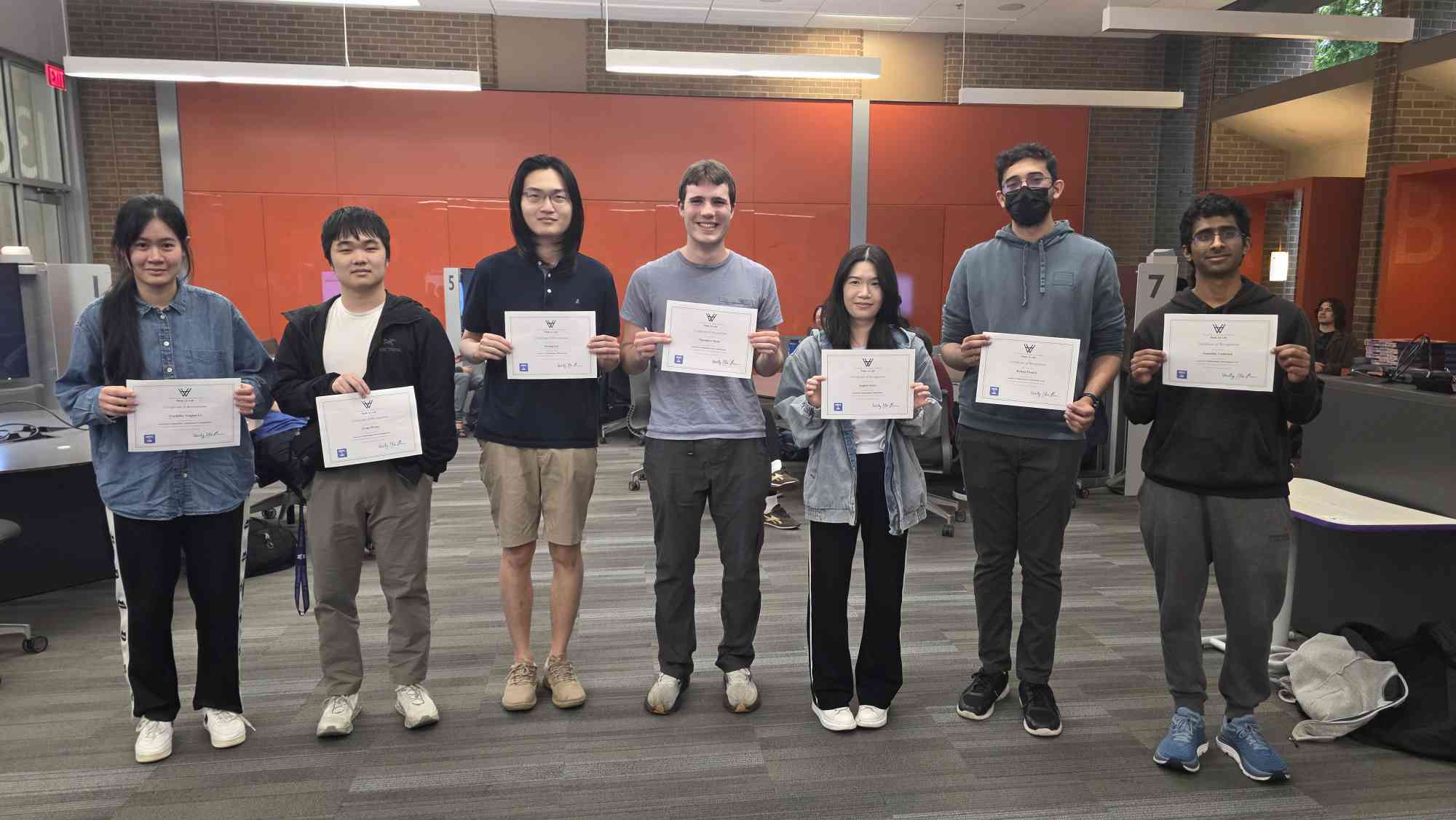
Join us for a Math AI Lab social day with board games, pizza, and time to celebrate the Lab's spring achievements, including ICLR publications, undergraduate research symposium posters, and mathlib contributions.
Leonardo de Moura, Senior Principal Applied Scientist in the Automated Reasoning Group at AWS and creator of Lean FRO
Lean is a proof assistant and programming language designed to make formal verification practical. In this talk, I will describe how Lean works, what it can do today, and where it is going. The core idea is simple: every mathematical claim and every program can be checked by a machine. This changes what collaboration looks like: between mathematicians, between engineers, and increasingly between humans and AI systems. When a proof is machine-checked, you do not need to trust the author. You just check it. I will discuss recent work on proof automation and AI-assisted formalization, including experiments where multi-agent AI systems work autonomously on Lean tasks. I will also describe the Lean FRO, a nonprofit building Lean as long-term open infrastructure for mathematics and verified software.
We hosted the Lean Hackathon as a focused gathering for Lean, formalized mathematics, and AI-assisted mathematics at the University of Washington.


From May 8 to 10, 2026, the lab hosted a hackathon bringing together the Lean, formalization, mathematics, and AI communities at the University of Washington.
Lean Projects
Geometric Measure Theory Commutative Algebra Algebraic Geometry Category Theory Formalization: zero-knowledge proofs Provable Computation in Lean
AI Projects
Lean error correction with LLMs Mathematician's copilot: Semantic Theorem Search Mathematician's copilot: Math2Vec CayleyPy: search on massive combinatorial graphs Reinforcement Learning for Polynomials AI for Quantum Code Compilation Deep learning for number theory
Vasily Ilin, Dhruv Bhatia
A weekly meeting for people interested in Lean. We do hands-on exercises and small demos. Topics include:
theorem proving in Lean meta-programming in Lean general-purpose programming in Lean
Vasily Ilin, Dhruv Bhatia
A weekly meeting for people interested in Lean. We do hands-on exercises and small demos. Topics include:
theorem proving in Lean meta-programming in Lean general-purpose programming in Lean
Vasily Ilin, Dhruv Bhatia
A weekly meeting for people interested in Lean. We do hands-on exercises and small demos. Topics include:
theorem proving in Lean meta-programming in Lean general-purpose programming in Lean
Vasily Ilin, Dhruv Bhatia
A weekly meeting for people interested in Lean. We do hands-on exercises and small demos. Topics include:
theorem proving in Lean meta-programming in Lean general-purpose programming in Lean
Sébastien Bubeck, OpenAI
I will review the progress of large language models for mathematics over the last 3 years, from barely solving high school level mathematics to solving some minor open problems in convex optimization, combinatorics and probability theory. The emphasis will be on trying to identify the shape of the current frontier capabilities, as it stands today, finding out both where it's helpful and where it's still falling short as a research assistant.
Vasily Ilin, Dhruv Bhatia
Weekly event to learn Lean in a collaborative way. There are no prerequisites to participate.
Wuyang Chen, Simon Fraser University, Assistant Professor
Recent progress in LLMs has transformed text and code generation, yet models still falter on PDEs (partial differential equation) where correctness, constraints, and physical consequences are critical. This talk explores how formal LLM reasoning can advance symbolic PDE modeling. First, our PDE-Controller formalizes informal PDEs, synthesizes solver-ready code, and plans subgoals to tackle nonconvex control via interactions with external solvers.
Second, our Lean Finder accelerates PDE formalization with a semantics-aware search engine for Lean/Mathlib that retrieves relevant theorems, outperforming GPT models and earning strong reception in the AI-for-math community. Together, these efforts aim to close the loop between automated reasoning and human heuristics across diverse, verifiable scientific tasks.
Vasily Ilin, Dhruv Bhatia
Weekly event to learn Lean in a collaborative way. There are no prerequisites to participate.
Vasily Ilin, Dhruv Bhatia
Weekly event to learn Lean in a collaborative way. There are no prerequisites to participate.
Please join us to hear about all the exciting work the Math AI Lab has been up to this quarter. This quarter's projects have been:
AI for Quantum Code Compilation Deep learning of number theory Formalizing Geometric Measure Theory Formalizing Stacks How good are language models at Lean? Lean error correction with language models Mathematician's copilot: reliable theorem search Monogenic extensions of regular local rings Provable Computation in Lean Reinforcement Learning for Polynomials Teaching a computer to knot
Maksym Zubkov
In this talk, I will give an overview of neuroalgebraic geometry, a new field, analogous to algebraic statistics, that uses algebraic geometry to understand different neural network architectures. Our main object of study will be a neuromanifold and its expressivity.
A neuromanifold is defined as an embedding of the parameter space of a fixed neural network into a fixed ambient space of functions, while expressivity is defined as the capability of a neural network to approximate an element in the ambient space arbitrarily well. We will consider two types of activation functions: polynomial and rational.
For each of these activation functions, we will construct the Zariski closure of a neuromanifold, called a neurovariety, and show that understanding the geometry of a neuromanifold or neurovariety is equivalent to understanding long-standing and beautiful objects of classical algebraic geometry such as secant varieties, Chow varieties, and others.
Finally, we will briefly discuss analogues of neuromanifolds over finite fields and show how simple point-counting can reveal further insights into the expressivity of neural networks and the geometry of a neuromanifold over the complex or real numbers.
Henry Kvinge, PNNL & UW
Examples play a critical role in the mathematician's workflow, enabling us to explore unfamiliar mathematical landscapes, building intuition and generating conjectures along the way. Of course, there are many settings where a far greater number of examples can be generated than could be manually examined by any one person. On the other hand, recent progress in AI has resulted in pattern recognition capabilities that can capture nuanced structural features in data at huge scales.
In this talk we discuss the use of AI for conjecture generation in algebraic combinatorics. We will start by describing what we have learned about the process of putting together a ‘math dataset' aimed at machine learning. We then describe our Algebraic Combinatorics Dataset Repository where we translated open problems and foundational results into a machine learning friendly format.
We then discuss a specific example where we used graph neural networks and mechanistic interpretability to re-discover several theorems which characterize mutation equivalence classes of quivers.
Alex Gu
Large language models (LLMs) have made steady progress in formal mathematics, achieving near-International Mathematical Olympiad (IMO) performance. This talk presents two complementary advances toward more capable and interpretable formal proving systems. First, we introduce LeanDojo, a foundational open-source toolkit bridging ML and Lean, enabling large-scale data extraction, interactive training, and the development of ReProver, a retrieval-augmented Lean prover.
Next, we turn to a critical challenge: proofs produced by LLMs are often unnecessarily long, redundant, and opaque. To mitigate this, we introduce ProofOptimizer, a system that automatically simplifies Lean proofs while preserving correctness. It combines symbolic linting, a fine-tuned 7B model, and iterative refinement, reducing proof length by up to 87% on MiniF2F and 57% on PutnamBench, even halving some IMO-level proofs.
Together, these systems demonstrate how AI can make automated proofs not only possible, but also increasingly comprehensible.
Vasily Ilin
If you have been curious about Lean -- the programming language to teach math to a computer -- but did not know how to get started, come Lean with us! The Math AI Lab is organizing this event to bring Lean beginners together, including level 0, to quote Panda Po. This is also a good way to engage with the UW Math AI Lab in order to participate in future research projects.
I will give a small demo that you will follow on your laptop right in the browser. We will probably start with the Natural Number Game and proceed to Glimpse of Lean.
Alexander Chervov, Institut Curie
We will present an AI-based open source Python library "CayleyPy" which can handle googol-size Cayley graphs and significantly outperforms classical computer algebra systems GAP/SAGE for several tasks. Hundreds conjectures and several results were obtained with its help. Classical group theory tasks e.g. decomposition of the group elements, can be rephrased as standard reinforcement learning tasks, and approached in a similar manner as Google Deepmind's AlphaGo/Zero.
We will also give an overview of various recent achievements in "AI for math" emerging field of research. The talk will be based on: arXiv:2509.19162, arXiv:2502.18663, arXiv:2502.13266.
Vasily Ilin
Seed-Prover is the current best Lean model, achieving 100% on minif2f, 50% on PutnamBench and gold-level performance on the 2025 IMO. I will briefly survey the history of formal theorem proving and talk about the Seed-Prover paper. You do not need to know Lean to understand the talk.
Carina Hong (Stanford Math / Stanford Law / Axiom AI)
Abstract:
The field of AI for Mathematics has moved its focus from solving benchmark problems with numerical solutions to generating formal proofs to research-level mathematical questions. In this survey talk we will cover recent developments and future directions in AI4Math, including the following three topics:
1. Formalization and auto-formalization, where natural language math contents (with LaTeX formulas) is converted into Lean, Isabelle, and Coq programs.
2. Automated theorem proving using LLMs, where transformer-based models now guide symbolic search of formal proofs and achieve competitive performances on benchmarks such as Mini-F2F and PutnamBench. 3. Conjecturing, where programming language helps with new knowledge generation in Euclidean Geometry and pairing conjecturer and prover gives advances in performance.
Eric Klavins, Professor at ECE, UW
I will describe our recent efforts to formalize, in Lean, fundamental concepts from engineering mathematics including signal processing, control theory, and formal verification. I'll start with an overview of the relationship between programming languages and formal logic, which provides an astounding avenue for programmers and engineers to learn and hopefully contribute to mathematics. I will give several examples of projects engineering students have explored.
I will then discuss various challenges, mainly to do with rigorous software engineering, that must be overcome before this kind of framework can be widely adopted in engineering.
Gal Yehuda, Yale University
Abstract:
What is the size of the smallest neural network that computes the parity function? How many hyperplanes are needed to slice the Boolean hypercube? In this talk we will discuss the connection between the problems as well as lower bounds, using methods from convex geometry, probability and combinatorics.
Come see what the Math AI Lab (aka eXperimental Lean Lab) has been up to this quarter. Undergraduates will present their work on the following projects:
What mathematical functions can neural networks learn? Reinforcement Learning for polynomials Auto-formalization with Language Models Metaprogramming in Lean Formalizing Polyhedral Geometry in Lean Counterexamples in Commutative Algebra in Lean Formalizing Zariski Spaces in Lean
Vasily Ilin
How does ChatGPT make pictures? Turns out it's a lot of SDEs, probability and a bit of optimization. I will introduce the basic building blocks of the algorithm, such as reversing the OU process, and will show some examples using the MNIST dataset of handwritten digits.
The eXperimental Lean Lab will showcase using Lean to formalize real mathematics. We have five groups formalizing 1) generating functions, 2) central limit theorem, 3) topology for algebraic geometry, 4) examples in commutative algebra, and 5) metaprogramming in Lean.
If you have been curious about using computers for proof assistance and verification, this talk is for you!
Herman Chau, University of Washington
In this talk, we will walk through how to formalize some examples from Herbert Wilf's "generatingfunctionology". We'll see how to define and work with power series in Lean, and work our way towards proving the closed form formula for the Fibonacci numbers. Along the way, we will discuss ways to structure Lean code to be readable from a mathematician's point of view.
Loading blog posts…